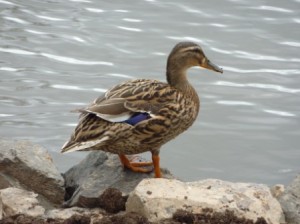
 The Mallard Duck is the most common wildfowl visitor to Hanley Swan Village Pond

The male Mallard duck is a Drake and is easily recognised by its metallic green head, brown breast, grey body, black tail and a white neck ring. In summer months (June to September) the Drake Mallard duck will moult and actually look very similar to the female. This process is called “eclipse” plumage, and provides good camouflage until they have fully replaced their flight feathers.
The female Mallard duck is called a Duck and is mainly brown, with blackish mottling, a plain buff coloured head with a dark line through the eye.
Both the Drake and the Duck have a purple-blue speculum, orange-red legs and a yellow-olive coloured bill, although the females bill is much duller. Younger ducks resemble the female Mallard duck, but tend to look duller.
The Mallard duck is quackers!
Here’s an interesting fact for when you next see a Mallard duck. When you hear a loud ‘Quack’ that will be coming from the female, as opposed to the male Mallard duck, whose call is a softer higher-pitched ‘quork’.
Feeding
In general the Mallard duck likes to forage near the waters surface or upend in the pond to reach for food deeper down. They also like to feed off the ground, and their diet should consists of cereals, plants and invertebrates. Feeding the ducks is something many people love to do, however beware that one food source that is very bad for ducks and wildfowl is WHITE BREAD, so this should be avoided at all costs. Read more about this subject here.
 Nesting
A Mallard duck likes to build a nest from leaves and grasses generally amongst dense vegetation. Their eggs are smooth and waxy, and are generally pale green or blue-green in colour. The egg size is about 57 mm by 41 mm and the female alone, incubates the eggs.
The ducklings are independent at birth, and covered in down with their eyes open, however the female will wait until the ducklings down is completely dry before taking them out on the water.
Normally breeding starts in March and a female Mallard duck will have around 1-2 clutches, producing 7-16 eggs. Incubation is normally 29 days and it will take about 50-60 days for the ducklings to fledge.
Mallard duck conservation
Because the Mallard duck is hunted between September to January they are now protected during the breeding season; however the non-breeding population has declined over the last 25 years which places the Mallard duck on the amber list species of conservation concern.
Pied piper brings the Mallard Duck lunch at Hanley Swan Pond

Fantastic pool. It’s the first place I visit when my husband and I are down at Blackmore.